
Brunswick County Criminal Court Records
A criminal court record is the court's case-level file. In Brunswick County, the Clerk of Superior Court maintains the court record after a criminal action enters the North Carolina court system. The file can begin with a warrant, magistrate order, citation, indictment, information, or other charging document. As the case moves, the record adds hearings, motions, bond orders, plea entries, dispositions, judgments, sentence terms, probation information, court costs, restitution, and compliance events.
Brunswick County criminal court records are split by court role. District Court handles many misdemeanors, infractions, traffic offenses, first appearances, and lower-level criminal calendars. Superior Court handles felonies, jury trials, higher criminal proceedings, and matters transferred or indicted for Superior Court action. Magistrates handle warrants, initial appearances, bonds, and related front-line duties within the District Court system. The court file is different from a jail roster, a sheriff incident report, or a state prison record.
For charge-level detail before the full court case is resolved, use the separate Brunswick County arrest records and court charges topic. For all civil, estates, family, traffic, and criminal case categories together, use the broader Brunswick County court records search path.
Search Brunswick County Criminal Court Records
The main online source is North Carolina eCourts Portal Smart Search. Smart Search provides public case summaries and Register of Actions information for public criminal actions. Official training says public case information may include case summary, case information, assignment information, party information, events, dispositions, hearings, and financial information when applicable. It is near real time, but the public version does not show every protected document or confidential record.
- Open Smart Search and enter the criminal case number or defendant name.
- Use Advanced Filtering Options to select Brunswick County as the location.
- Narrow by case type, case status, filing date, or identifying fields when a common name returns many records.
- Open the public case summary to review charges, events, hearings, disposition, sentence, and financial items.
- Request certified copies or older paper-file documents from the Clerk of Superior Court when online results are not enough.
Portal results are not the same as a formal criminal-history background check. The NC Judicial Branch court-records guidance says people doing background checks should use the county clerk's office. In Brunswick County, the Clerk's main line is (910) 253-3900, and the Criminal Division contact listed in the court directory is (910) 253-3902.
Brunswick County Criminal Case Flow
Brunswick County criminal court records grow in stages. A case may begin with arrest paperwork, a citation, a warrant, or a magistrate order, then move into court hearings and filings. Felony matters may begin in District Court for initial proceedings and move to Superior Court after indictment or transfer. Misdemeanors and infractions often remain in District Court unless appealed or otherwise moved by law.
Case flow: Charges Filed › Arraignment › Pretrial / Motions › Plea or Trial › Disposition › Sentencing
| Stage | What Happens |
|---|---|
| Charges Filed | The charge enters court through a warrant, citation, indictment, information, magistrate order, or other charging paper. |
| Arraignment | The charge is formally addressed, and the plea process begins under the assigned court rules. |
| Pretrial / Motions | The record may show bond matters, discovery issues, continuances, motions, orders, and hearing settings. |
| Plea or Trial | The case may resolve by plea, trial verdict, dismissal, or another disposition event. |
| Disposition | The case or charge outcome is entered, such as guilty, not guilty, dismissed, responsible, or not responsible. |
| Sentencing | The record may show custody, probation, restitution, costs, fines, community service, or compliance terms. |
What Brunswick County Criminal Records Show
A Brunswick County criminal court record should be read field by field. The charge line tells what was alleged. The event history tells what happened in court. The disposition tells the result. The sentencing and financial fields tell what the court ordered after a conviction or responsibility finding. A public case summary may not include every underlying document, and sealed or expunged material may be absent.
| Field | What It Shows |
|---|---|
| Case Number | The Enterprise Justice identifier for the Brunswick County criminal action. |
| Defendant | The person charged, with party role and attorney links when public. |
| Charges | Charge description, count, offense level, statute or offense text, and related case reference when public. |
| Bond / Release | Bond amount, secured or unsecured conditions, recognizance, or custody-related entries when shown. |
| Hearings | Court dates, hearing type, courtroom, judge or assignment, and continuance entries when public. |
| Plea | Guilty, not guilty, no contest where applicable, or other plea-related entry. |
| Disposition | Dismissed, guilty, not guilty, disposed, responsible, not responsible, judgment entered, or another outcome. |
| Sentence | Custody, probation, suspended sentence, fines, costs, restitution, or other court-ordered terms. |
| Financial Information | Costs, fees, restitution, probation or parole fees, attorney fees, and payment eligibility. |
The NC Judicial Branch expunction source is relevant to Brunswick County criminal court records because it explains when eligible criminal information may be removed from public access.
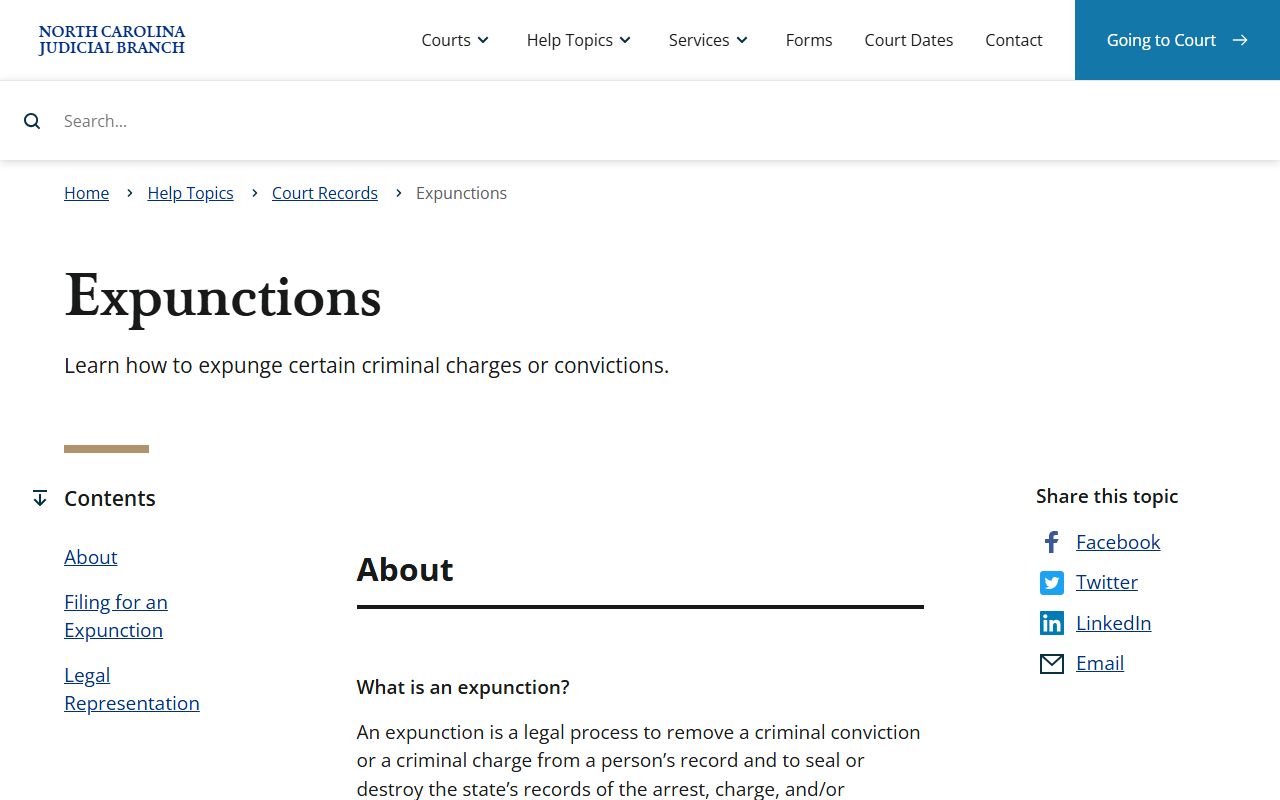
The expunction source also shows why an older charge may not appear in the same way as a current public criminal case.
Charges vs Convictions
Brunswick County criminal court records can show charges that did not end in convictions. A charge is an accusation filed through the criminal process. A conviction is an outcome after a guilty plea, trial verdict, or other conviction result. Dismissed charges, acquittals, reduced charges, and amended charges can remain important parts of the record, but they should not be described as convictions unless the disposition supports that reading.
| Point | Charge | Conviction |
|---|---|---|
| Meaning | An allegation that an offense occurred. | A final result based on plea, verdict, or qualifying judgment. |
| When it appears | Early in the court case after filing or charging. | After plea, trial, or judgment entry. |
| Record risk | May be dismissed, amended, reduced, or superseded. | May carry sentence, probation, costs, or collateral effects. |
| How to verify | Read the charge line and event history. | Read the disposition, judgment, and sentence fields. |
Note: A charge line alone does not prove guilt; always read the disposition and sentence fields.
Read Brunswick County Criminal Dispositions
Disposition is the outcome field. In Brunswick County criminal court records, it may show guilty, not guilty, dismissed, disposed, responsible, not responsible, judgment entered, or another case-specific result. A single case can have more than one charge, and each charge may have its own result. One charge may be dismissed while another leads to a plea or conviction. That is why charge-level reading matters.
Sentence information is the next layer. A conviction or responsibility finding may carry custody, probation, suspended sentence terms, restitution, costs, fines, community service, treatment conditions, or other compliance requirements. The financial section may show court costs, attorney fees, probation or parole fees, restitution, and payment status. Make Payments in the Portal covers eligible items, but not every criminal financial obligation can be paid online.
- Dismissed
- The charge or case was ended without a conviction in that posture.
- Probation
- Court-ordered supervision instead of or after custody.
- Restitution
- Money ordered to compensate a victim.
- Continuance
- A postponement of a hearing or trial date.
Sealed vs Expunged Criminal Records
Restricted criminal court records are not all restricted for the same reason. A sealed record is hidden from normal public view by law or court order, but it may still exist for authorized users. An expunged record is handled through a statutory removal process. The practical result can be strong public-access protection, but eligibility is narrow and fact-specific.
| Point | Sealed | Expunged |
|---|---|---|
| Public visibility | Hidden from ordinary public access. | Removed from public criminal-history access if granted. |
| How it happens | By statute, rule, or court order. | By petition and statutory eligibility process. |
| North Carolina examples | Juvenile, mental health, adoption, protected identifiers, or court-sealed filings. | Eligible adult records under statutes such as N.C.G.S. 15A-145.5 and eligible juvenile records under Chapter 7B. |
| What to do | Ask the Clerk what access rules apply to the specific file. | Use Judicial Branch expunction forms and consider counsel for complex history questions. |
Public Access to Brunswick County Criminal Records
Public access to Brunswick County criminal court records is based on both open-records principles and court-record statutes. N.C.G.S. 132-1 defines North Carolina public records broadly, subject to exceptions. Portal training cites N.C.G.S. 7A-109(b) for public court index categories, including criminal actions and judgment indexes. The Clerk's public terminals and case files remain essential when a user needs a more complete court record than the online case summary.
Some criminal records are outside public Portal access. Juvenile court records are subject to Chapter 7B confidentiality rules. The research source inventory cites N.C.G.S. Chapter 7B Article 30 for juvenile record confidentiality and N.C.G.S. 7B-3200 for juvenile expunction. Adult expunction of certain nonviolent misdemeanor and felony convictions may involve N.C.G.S. 15A-145.5, but eligibility depends on the full record.
Key Statutes:
N.C.G.S. 132-1 defines public records in North Carolina, subject to statutory exceptions.
N.C.G.S. 15A-145.5 governs expunction for certain nonviolent misdemeanor and felony convictions.
State and Federal Criminal Records
Brunswick County criminal court records are local state-court records. They are separate from state prison, probation, parole, federal criminal, and federal custody records. The North Carolina Department of Adult Correction offender search covers state prison offenders, probationers, and parolees, and the research notes that DAC does not include county jail information. County jail custody is handled through the Brunswick County Sheriff's Office, while the court case is handled through eCourts and the Clerk.
Federal criminal records are also separate. Brunswick County is in the Eastern District of North Carolina for federal cases, and federal case access runs through PACER and the federal court system rather than county eCourts. The U.S. Attorney's Office Eastern District overview source explains the federal district context and the appeal path to the Fourth Circuit.
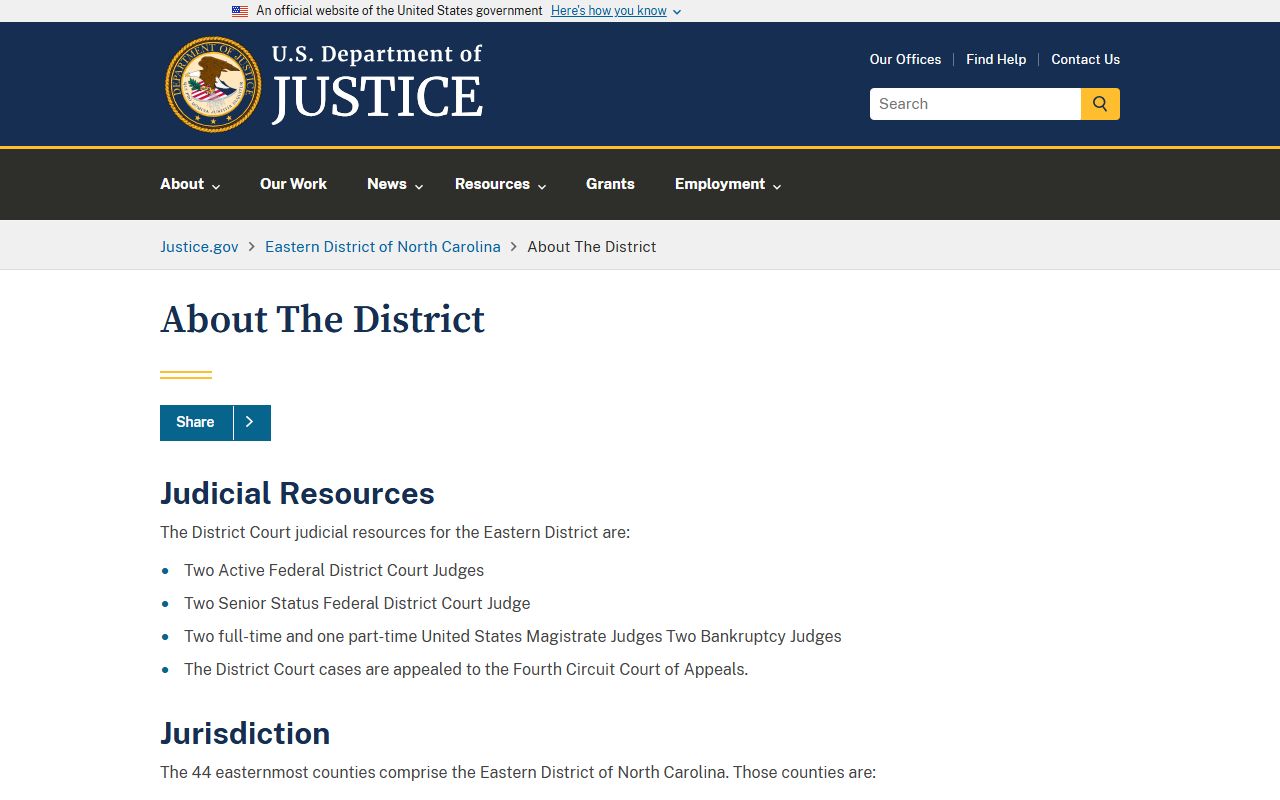
The federal source is useful for separating Brunswick County criminal court records from federal prosecutions that do not appear as county court cases.
Criminal Background Check Limits
A public Brunswick County criminal court records search is not the same as a regulated employment, tenant, credit, or insurance background report. Public case lookup can help a person find court events, dispositions, and case numbers, but it may be incomplete if the record is sealed, expunged, confidential, old, misidentified, or not yet updated. NC Judicial Branch specifically directs background-check users to the county clerk's office rather than relying only on Portal.
For formal use, ask the Clerk for the exact copy type needed. Certified judgments, dismissal orders, and disposition printouts may be required for licensing, school, immigration, military, professional, or court purposes. If the record is not found online, bring the case number, defendant name, approximate date, charge, and court level to the Clerk's office.
Important: Public case lookup is not a consumer report and should not be used for FCRA-regulated decisions.
Restricted Brunswick County Criminal Records
Restricted Brunswick County criminal court records include juvenile matters, sealed filings, expunged cases, protected identifiers, adoption-related items, many mental health records, and documents made confidential by court order or statute. Public results may also omit sensitive witness, victim, minor, Social Security, account, address, or medical information. A missing Portal result does not always mean no case ever existed.
Expunction should be handled carefully. The research file says a Brunswick County resident should identify the exact case number, charge, disposition, date of disposition, and court of conviction or dismissal before filing. The petition is generally filed in the county where the charge or conviction occurred unless a statute says otherwise. The District Attorney may receive notice, a hearing may be required, and the Clerk processes the order if granted.